02 September 2013

Space reentry vehicles, part 5


Part 5: More on the detached shock wave

(index)

The term detached shock wave originally referred to an undesirable aerodynamic effect that was found in supersonic projectiles such as bullets.  This type of shock wave was of interest because it had a lot more drag and aerodynamic instability than an attached one.

The first aircraft designed to be supersonic, the Bell X-1, was modelled after the shape of a 0.5 calibre Browning machine gun bullet, which was known to be stable in supersonic flight.

04 August 2013

Space reentry vehicles, part 4


Part 4: More on ablation

(index

In 1907 American chemist Leo Baekeland invented Bakelite, the world's first plastic.  50 years later it would be chosen as the main ingredient in NASA's reentry capsule heat shields. 

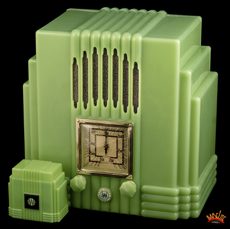
Radio made of Bakelite 

Bakelite was a good choice for spacecraft heat shields because it's a good insulator of heat; it has high strength;  it has an abundance of carbon (a material with a high latent heat); and it has an ability to char rather than melt at high temperature.

21 July 2013

Space reentry vehicles, part 3


Part 3: ICBMs and the cold war

(index)

Other than vehicles with a detached shock wave, all aircraft heat up more the faster they move.  From the NASA book Facing the Heat Barrier: A History of Hypersonics [1]
At Mach 3 and higher, there was the Lockheed SR-71 that cruised at 85,000 feet. The atmosphere at such altitudes, three times higher than Mount Everest, has a pressure only one-fiftieth of that at sea level. Even so, this airplane experienced aerodynamic heating that brought temperatures above [260C] over most of its surface.
The SR-71 Blackbird gets to 260C over most of its surface.  Aluminium anneals (softens) at 177C (alloys can be higher) making it unsuitable as a material for use on the outside of the Blackbird.  The Blackbird used titanium instead.

18 July 2013

Recent ISS spacewalk water leak


Recently, a spacesuit sprung a water leak and the suit started filling with water, such that the astronaut's life was in danger and the "spacewalk" had to be aborted.

As I mentioned in my space reentry vehicle posts (index), if every reentry vehicle of the capsule type (possible exception of the Space Shuttle) is fake, and the only way astronauts can get back to earth is via such capsules, then the International Space Station is fake too*.

One can look through spacewalk footage to find bubbles coming up.  You can also see scuba gear.  Here's another example:


15 July 2013

Space reentry vehicles, part 1


Part 1: ablation and the detached shock wave

part 2   (index)
 

(Update 3/9/2013: Please note I've updated my view of the detached shock wave since first writing this post.  I now accept that there is a detached shock wave in the sense of a bow shock, but it is not detached in the thermal sense, as claimed by NASA. More in part 5.)

===============================

Most meteoroids burn up almost immediately on entering earth's atmosphere.  The few larger ones that make it to the ground lose 95 - 99% of their mass.  The air around them gets so hot it disassociates to become plasma.  95% of the glowing streak of a meteor is hot air, not hot rock.  According to NASA the temperature of the leading face of ICBMs returning from space is "hotter than the surface of the sun", (5500C+).

Space reentry vehicles, part 2


Part 2: aerodynamics

part 1   (index)

Early on in the design of manned reentry vehicles it was realised that the huge heat and strain of reentry would destroy any protuberances such as wings, rudders etc.  This lead to the minimal design of spheres and cones:


23 June 2013

Is space cold? Part 1


During Apollo 13 an explosion on the way to the moon damaged the service module, causing astronauts James Lovell, Jack Swigert, and Fred Haise to abort what would have been the third landing on the moon.  They came back to earth with the CM LEM and damaged SM.  The SM and LEM were jettisoned shortly before re-entering earth's atmosphere in the CM*.

Is space cold? Part 2


part 1


In part one it was suggested that an object in the sun at distances of earth orbit, or less, will be hot.  What about the case for the shade in space, is it cold? 

Some say that when the Apollo astronauts moved from light to shadow on the surface of the moon, they went from a hot 107C or so to a cold -170C in a matter of seconds.

Neil Armstrong on the surface of the moon during Apollo 11

11 June 2013

The porous plate sublimator


Surviving the harsh lunar environment is apparently one of mankind's greatest engineering achievements. 

The space suit worn by the Apollo astronauts on the surface of the moon had to protect them from UV, X, and gamma-rays, heat, and solar flare radiation from the sun; cosmic rays; micro meteors; regulate humidity, carbon dioxide and oxygen; and maintain a pressurised layer of air.

Amazing life-saving suit technology: the state of the art in 1969.  The Apollo 11 suit.

28 May 2013

Anthony Watts experiment to prove the greenhouse effect

Anthony Watts recently performed an experiment in an attempt to show that one can get free energy by putting a hot object in front a mirror.  

This was in an attempt to defend the theory of the greenhouse effect.  It was a noble and valient attempt I must say, and I'm glad he shared it with us.  But it was an attempt that was ultimately doomed to failure.

22 May 2013

Bill Nye the unscience guy

The recent Oklahoma tornado is a top-ranked F5 one, although not as big as a 1999 one (see WUWT post here).

It's a shame to see this happening in the mainstream media, but CNN immediately seized upon the event to talk up the climate change angle.  Within hours of the latest Oklahoma tornado Piers Morgan and Bill Nye were linking it to climate change.

The terms now used are climate change and climate disruption.  The term global warming is apparently completely out of favour.

19 May 2013

NASA Apollo moon landing faked 2

Continuing on from part 1, here are three more points against the official story of the moon landing:
   
5)   One astronaut has shadow twice as long as other


==================================


3)    Laminated photo on the surface of the moon

In my opinion this is one of the stronger points -- a real doozy for the Apollo faithful to explain away.

Apollo 16 photos AS16-117-18839, AS16-117-18840 and AS16-117-18841.

16 May 2013

NASA Apollo moon landing faked 1


Each year that passes after the Apollo moon landings took place and we do not repeat this feat by returning man to the moon, shows that these missions were an anomaly rather than the new standard they were supposed to be.  

For example, why don't we just use the 1960's technology to go back to the moon and beyond, that seemed so easy from 1969 - 1972?  Why didn't the frontier of space really dawn for humanity as was promised during the 1950s and 60s?