Showing posts with label bogus reentry vehicles. Show all posts

25 July 2019

Express covered my video on fake manned space travel

https://www.express.co.uk/news/weird/884902/ISS-hoax-wires-NASA-fake-anti-gravity-International-Space-Station

Heh thanks Express. I had no idea that they covered my video about the faking of all manned space travel about two years ago.
I still haven't finished the bigger part two I have planned. But it will be done one day. Luckily many others are picking up the ball too. Judging by the comments on youtube Apollo videos there's a mass awakening now that the moon landings were fake. 50 years on and we still can't go back!


04 May 2014

Bogus Reentry Vehicles (Video part 1 of 2)

The first half of my expose on the faking of all manned space travel.


The description from the video:
 
Part 1 concerns the International Space Station hoax. Part 2 concerns details of the reentry vehicles and how they would burn up on atmospheric entry. I'll put link to part 2 here when it's done.

13 September 2013

Space reentry vehicles, part 7


Part 7: Pressure

At subsonic speed, below Mach 0.3, the pressure of the air coming into the hull of an aircraft is roughly 1/2ρv2 where ρ is the density of the fluid medium; for air at sea level = 1.225 kg/m3.  The equation for compressible flow given for above Mach 1 speeds goes as the power of 3.5 rather than 2 and rises much more quickly.

12 September 2013

Space reentry vehicles, part 6


Part 6: Control

(index)

After atmospheric reentry the heat shields on the bottom of space reentry capsules have a characteristic burn pattern that starts at a point off centre and emanates to the edge. 

Gemini heat shield after reentry

The central point of the burn pattern is the stagnation point where the air isn't moving parallel with respect to the surface but hits it at right angles.  The temperature and pressure is at a maximum at the stagnation point such as the following diagram depicts:

02 September 2013

Space reentry vehicles, part 5


Part 5: More on the detached shock wave

(index)

The term detached shock wave originally referred to an undesirable aerodynamic effect that was found in supersonic projectiles such as bullets.  This type of shock wave was of interest because it had a lot more drag and aerodynamic instability than an attached one.

The first aircraft designed to be supersonic, the Bell X-1, was modelled after the shape of a 0.5 calibre Browning machine gun bullet, which was known to be stable in supersonic flight.

04 August 2013

Space reentry vehicles, part 4


Part 4: More on ablation

(index

In 1907 American chemist Leo Baekeland invented Bakelite, the world's first plastic.  50 years later it would be chosen as the main ingredient in NASA's reentry capsule heat shields. 

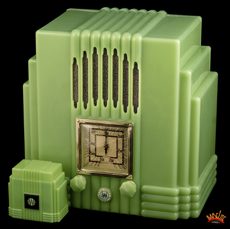
Radio made of Bakelite 

Bakelite was a good choice for spacecraft heat shields because it's a good insulator of heat; it has high strength;  it has an abundance of carbon (a material with a high latent heat); and it has an ability to char rather than melt at high temperature.

21 July 2013

Space reentry vehicles, part 3


Part 3: ICBMs and the cold war

(index)

Other than vehicles with a detached shock wave, all aircraft heat up more the faster they move.  From the NASA book Facing the Heat Barrier: A History of Hypersonics [1]
At Mach 3 and higher, there was the Lockheed SR-71 that cruised at 85,000 feet. The atmosphere at such altitudes, three times higher than Mount Everest, has a pressure only one-fiftieth of that at sea level. Even so, this airplane experienced aerodynamic heating that brought temperatures above [260C] over most of its surface.
The SR-71 Blackbird gets to 260C over most of its surface.  Aluminium anneals (softens) at 177C (alloys can be higher) making it unsuitable as a material for use on the outside of the Blackbird.  The Blackbird used titanium instead.

15 July 2013

Space reentry vehicles, part 1


Part 1: ablation and the detached shock wave

part 2   (index)
 

(Update 3/9/2013: Please note I've updated my view of the detached shock wave since first writing this post.  I now accept that there is a detached shock wave in the sense of a bow shock, but it is not detached in the thermal sense, as claimed by NASA. More in part 5.)

===============================

Most meteoroids burn up almost immediately on entering earth's atmosphere.  The few larger ones that make it to the ground lose 95 - 99% of their mass.  The air around them gets so hot it disassociates to become plasma.  95% of the glowing streak of a meteor is hot air, not hot rock.  According to NASA the temperature of the leading face of ICBMs returning from space is "hotter than the surface of the sun", (5500C+).

Space reentry vehicles, part 2


Part 2: aerodynamics

part 1   (index)

Early on in the design of manned reentry vehicles it was realised that the huge heat and strain of reentry would destroy any protuberances such as wings, rudders etc.  This lead to the minimal design of spheres and cones: